

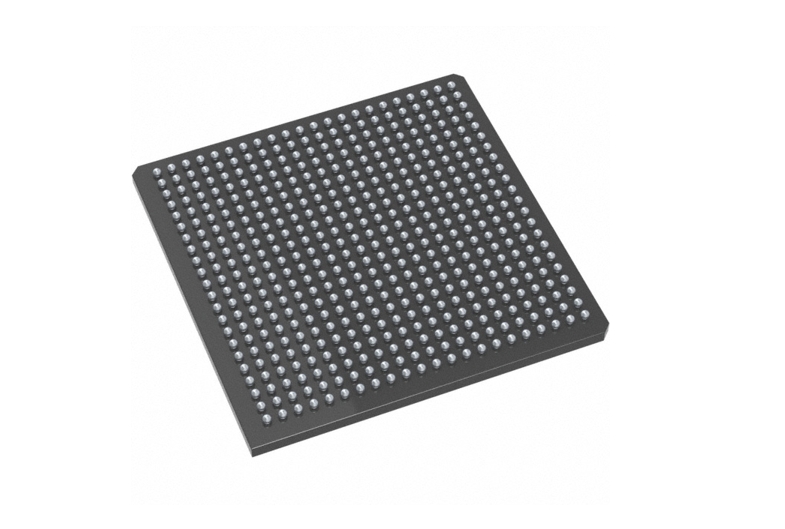
Why Is the TMS320F28335PGFA Especially Suitable for Motor Control?
The TMS320F28335PGFA is a 32-bit C2000 Delfino microcontroller from Texas Instruments. It uses the TMS320C28x core at 150 MHz and includes a single-precision floating-point unit. For motor control, these features matter because field-oriented control requires many mathematical transforms, fast current loops, and precise PWM signals. The device brings these needs together in one industrial-grade chip.
1. A Real-Time Core with Floating-Point Power
Motor control algorithms such as Clarke and Park transforms, space-vector PWM, and PI regulators are math-heavy. On a fixed-point microcontroller, engineers must manually scale variables into Q formats, which increases development time and risks overflow or precision loss. The F28335 includes an IEEE 754 FPU, so these algorithms can be written directly in C. The 150 MHz core executes 32×32 MAC operations in a single cycle, allowing fast current and speed loops. This shortens development and improves code readability.
2. PWM and ADC Peripherals Designed for Motor Drive
The device provides up to 18 ePWM outputs, including six HRPWM channels with 150 ps micro-edge positioning. High-resolution PWM reduces harmonic distortion and improves low-speed torque smoothness. The 12-bit ADC has 16 channels and an 80 ns conversion time, and it can be triggered by PWM events. This synchronization ensures that phase currents are sampled at the correct instant. Three analog comparators add fast overcurrent and fault protection without software delay. Together, these peripherals support accurate current control and safe power-stage operation.
3. Complete Feedback Interfaces
Motor control requires position and speed feedback. The F28335 offers two eQEP interfaces for incremental encoders and Hall sensors, and up to six eCAP inputs for pulse capture, frequency measurement, and event timing. A six-channel DMA reduces CPU load by moving ADC results and communication data automatically. This combination allows a single chip to handle current, speed, and position loops while still leaving CPU time for diagnostics and communication.
4. Memory, Communication, and Integration
The 256K×16 flash and 34K×16 SARAM provide enough space for complex motor control code, parameter tables, and real-time variables. Communication interfaces include eCAN, SCI, SPI, I2C, and McBSP. These ports allow the controller to connect to gate drivers, encoders, host controllers, and industrial networks. Up to 88 GPIO pins give flexibility for multi-axis or multi-motor systems. The 176-pin LQFP package offers a practical balance between pin count and board space.
5. Reliability and Safety
Industrial motor drives must operate in noisy and hot environments. The F28335 supports -40°C to +85°C operation and includes a 128-bit security key and lock to protect firmware. Its clock system, watchdog, and low-power modes help maintain reliable operation. These features make it suitable for servo drives, variable-frequency drives, robotics, and electric vehicle subsystems.
Feature-to-Motor-Control Mapping
| Device Feature | Motor-Control Benefit |
|---|---|
| 150 MHz C28x core with FPU | Fast floating-point FOC, PID, and SVPWM calculations |
| Up to 18 ePWM, 6 HRPWM | Precise inverter control and low harmonic distortion |
| 12-bit ADC, 80 ns, 16 channels | Fast phase-current and bus-voltage sampling |
| eQEP and eCAP | Encoder, Hall, and pulse feedback for speed and position |
| eCAN, SCI, SPI, I2C | Communication with drivers, hosts, and networks |
| 256K flash, 34K SARAM | Space for complex control code and real-time data |
Questions and Answers
Q1: Why is the FPU important for motor control?
A1: It allows Clarke, Park, PID, and SVPWM algorithms to be written directly in C without Q-format scaling. This reduces development effort and improves numerical accuracy.
Q2: How does HRPWM help motor drive performance?
A2: HRPWM provides 150 ps edge resolution, which improves duty-cycle accuracy. This reduces current ripple, harmonic distortion, and torque pulsation, especially at low speed.
Q3: What feedback interfaces are available?
A3: Two eQEP modules support incremental encoders and Hall sensors, while up to six eCAP inputs capture pulses for speed, position, and event timing.
Q4: Can the F28335 control multiple motors?
A4: Yes. With up to 18 PWM channels, multiple ADC channels, and abundant GPIO, it can support multi-axis or multi-motor systems when properly configured.
Q5: What development tools are commonly used?
A5: Code Composer Studio is the main IDE. TI also provides C2000Ware, motor control libraries, and digital power libraries for faster implementation.
Conclusion
The TMS320F28335PGFA is especially suitable for motor control because it combines a floating-point real-time core, high-resolution PWM, fast ADC, complete feedback interfaces, and reliable communication. These features allow engineers to implement advanced motor control algorithms on a single industrial-grade microcontroller.